|
I am an AI Research Scientist at HyperbeeAI. I received my PhD in Computer Science from Koç University in 2026, where I was advised by Deniz Yuret and was an AI Research Fellow at the KUIS AI Center in Istanbul. My thesis, Vector Retrieval-Augmented Language Models: What Retrieval Can and Cannot Replace, measured where retrieval can stand in for a language model's parameters: it can for knowledge, but not for reasoning. My research focuses on memory augmentation for language models. Email / CV (EN / AR) / Semantic Scholar / Google Scholar / ORCID / GitHub / Hugging Face / X |
|
|
I am interested in natural language processing, language modeling (both large and small models),
and deep learning in general. My PhD research studied vector retrieval as external memory for
language models, both episodic memory of a long document the model is reading and
semantic memory of general world knowledge. Both rest on
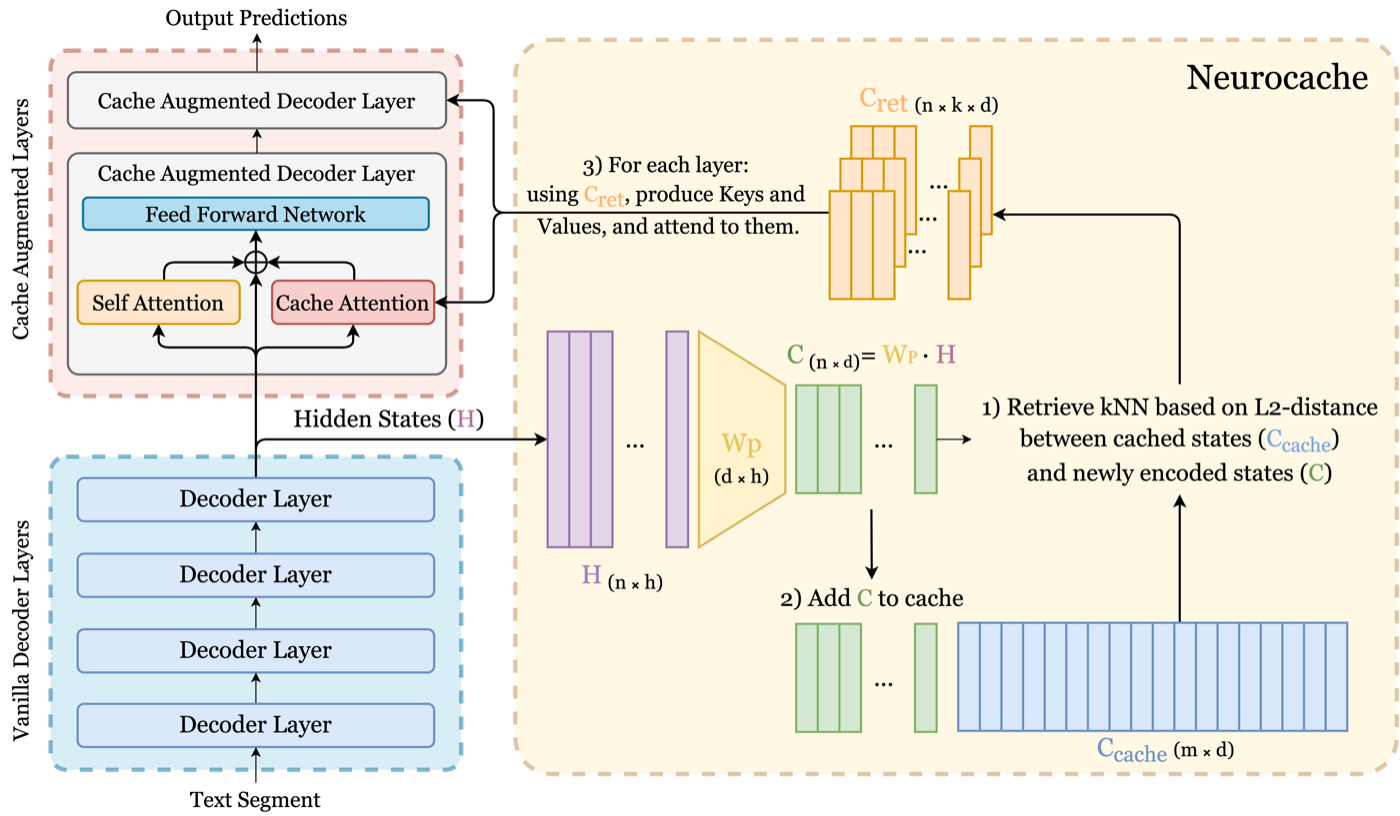
Neurocache, which retrieves hidden states
instead of text: it runs k-nearest-neighbor search over cached states at a middle layer of a frozen
pre-trained model and passes what it finds to the upper layers through a separate cache-attention
module. Against text retrieval, neither side wins everywhere: the cache loses open-web question
answering, but wins lexical and structured lookup, and wins multi-hop questions for far less
computation. A small model with this memory beats a larger model trained the same way on knowledge
questions, and editing the store changes the model's answers with no weight update. Its main
limitation is that it cannot tell when what it retrieved is wrong, or when the answer is
absent.
|
|
|
|
Ali Safaya, Deniz Yuret NAACL 2024 ACL Anthology / arXiv / Code Neurocache extends the effective context of large language models with an external vector cache of compressed past states, retrieved through efficient k-nearest-neighbor lookup and fused back into the attention layers. |
|
Ali Safaya · Turkish Data Depository 2B-parameter Turkish LLM · Hugging Face Model card Kanarya is a 2-billion-parameter Turkish language model based on the GPT-J architecture, pretrained on large-scale filtered Turkish web text and released openly for Turkish text generation and NLP research. |
|
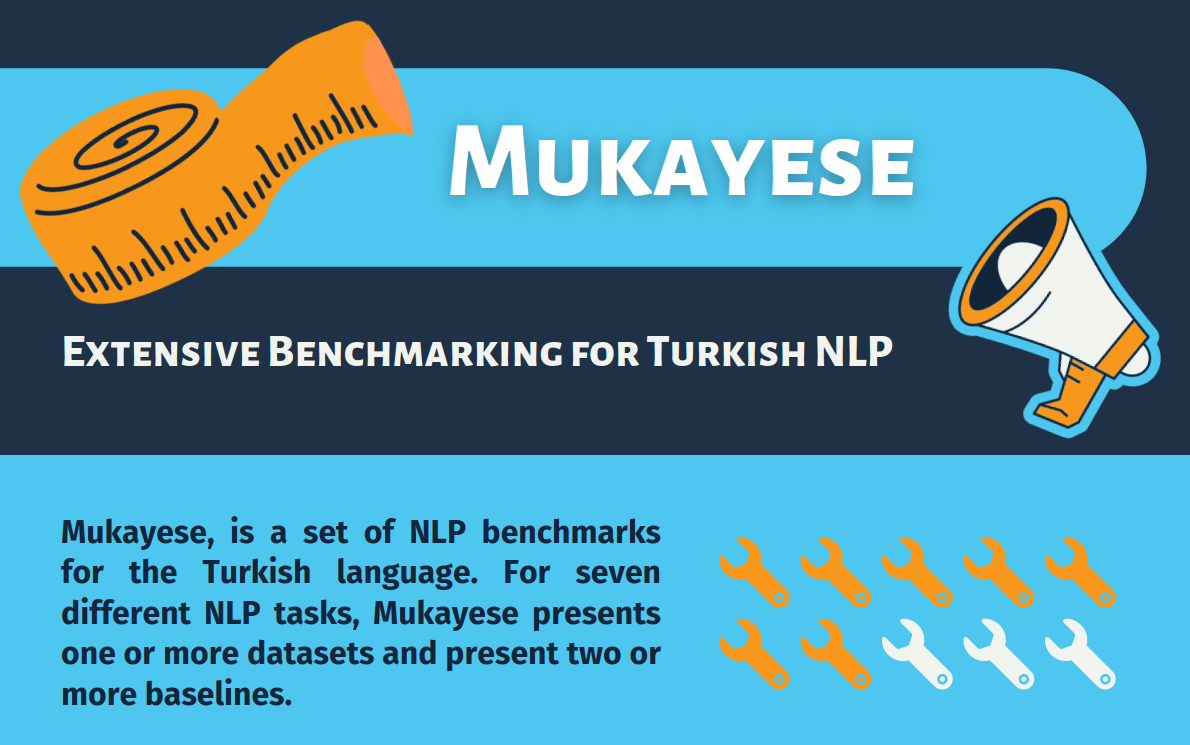
Ali Safaya, Emirhan Kurtulus, Arda Goktogan, Deniz Yuret Findings of ACL 2022 Project page / Video / ArXiv Mukayese is a collection of NLP benchmarks for the Turkish language, consisting of seven leaderboards for different NLP tasks. For each benchmark, we work with one or more datasets and present two or more baselines. |
|
|
|
|
|
This website is based on Jon Barron website's source code. |